
Why Sun Care Is the Most Important Step in Your Skincare Routine
Why Sun Care Is the Most Important Step in Your Skincare Routine
Ask any dermatologist what single thing would improve your skin most, and the answer is almost always the same: wear sunscreen. Every day. No exceptions. Not because it's trending. Because of what UV radiation does to skin over time, and because everything else you apply works better when you protect it first.
The damage happens before you notice it
UV radiation doesn't announce itself. You don't feel collagen breaking down. You don't notice DNA damage accumulating in skin cells. By the time dark spots, fine lines, or uneven texture show up, years of exposure have already done their work.
Two types of UV rays matter here. UVB causes visible sunburn: the redness and peeling most people associate with sun damage. UVA goes deeper. It breaks down collagen and elastin (the proteins that keep skin firm), and it's present at steady levels year-round, including on cloudy days and through glass. Most of what people call "premature aging" is cumulative UVA damage that built up quietly over years of unprotected skin.
For Indian skin, melanin does offer some natural protection: higher melanin levels mean a slightly higher natural SPF. But "slightly" is doing a lot of work in that sentence. It's not enough to prevent tanning, hyperpigmentation, or long-term structural damage. Darker skin tones are also more prone to post-inflammatory hyperpigmentation, which UV exposure can trigger and worsen.
Sunscreen protects everything else you're doing, too
Sunscreen doesn't just protect your skin. It protects every other product in your routine, and people rarely think about it that way.
Using a brightening serum with alpha-arbutin or niacinamide to fade dark spots? UV exposure will keep triggering melanin production faster than the serum can slow it down. Using retinol or glycolic acid? Those make skin more photosensitive. Skipping sunscreen while using them doesn't just neutralise the benefits. It actively makes your skin worse.
Sunscreen is what lets everything else work. Without it, you're putting out a fire with one hand and stoking it with the other.
The white cast problem
The most common reason people in India skip daily sunscreen is the white cast. Mineral sunscreens with zinc oxide or titanium dioxide, while effective, leave a grey or white tint on deeper skin tones. That's a real barrier, not vanity.
Chemical sunscreens absorb UV rather than reflecting it, so no white cast, though they can irritate sensitive skin. Hybrid formulas combine both and tend to work for most people. Bottom line: the best sunscreen is the one you'll actually use. An SPF 50 sitting in your cabinet protects nothing.
Reapplication is the step most people skip entirely. Sunscreen breaks down with UV exposure, sweat, and touch. Outdoors, you need to reapply every three to four hours. A single morning application doesn't last the day.
What Indian skin actually needs in a sunscreen
Broad-spectrum coverage (UVA and UVB) is non-negotiable. SPF 50 is right for daily use in India, where UV index levels are high most of the year. PA+++ or PA++++ ratings indicate UVA protection specifically: that's the system most Indian and Asian brands use, and it's worth understanding.
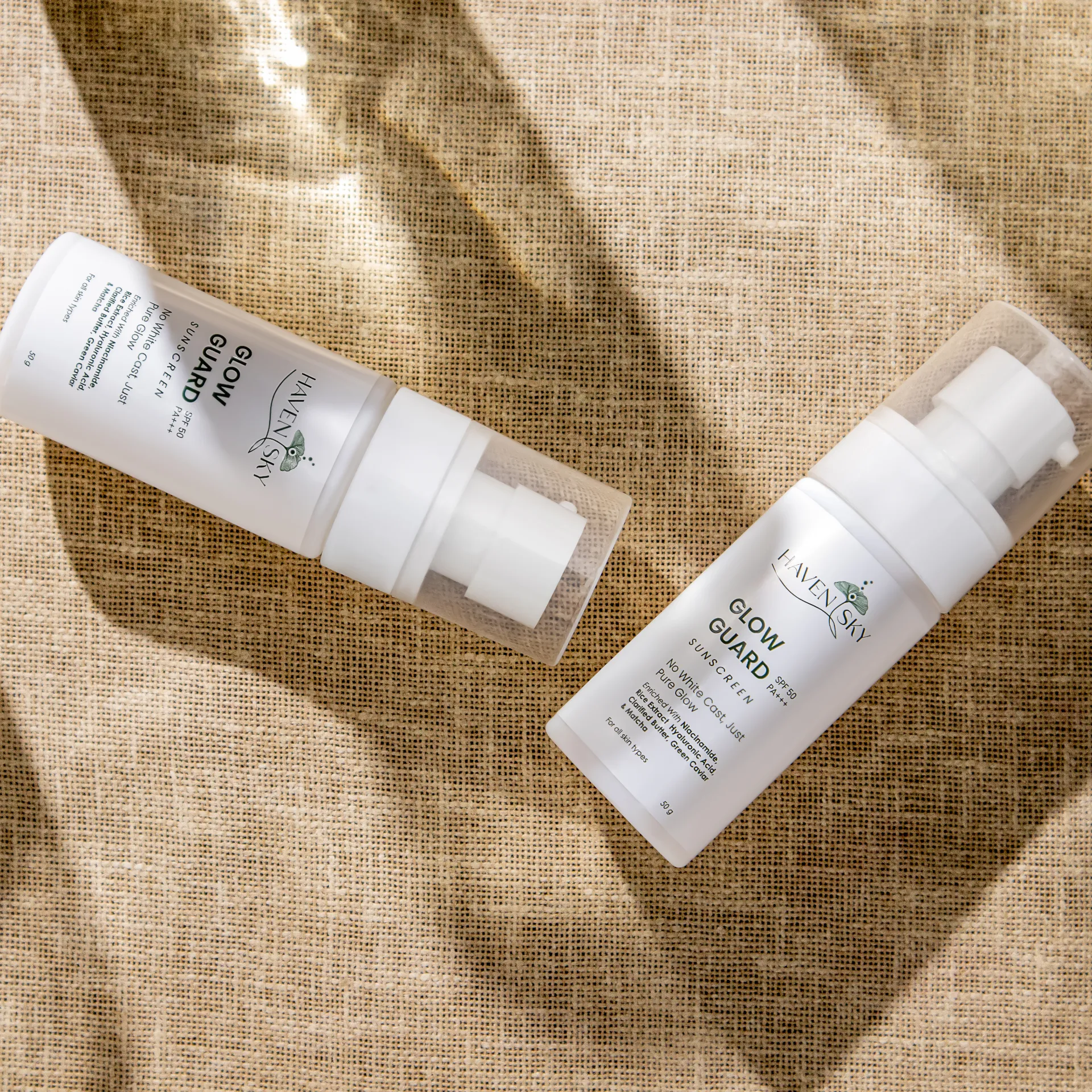
Niacinamide helps with oil control and pigmentation. Hyaluronic acid adds hydration without heaviness. Haven Sky's Glow Guard Sunscreen (SPF 50 PA+++) has both, along with rice extract and matcha for antioxidant support, and it's formulated to avoid white cast on Indian skin tones. If texture or finish has kept you off SPF before, it's a good place to start.
Start here
If you're working on your skin and skipping sunscreen, almost nothing else you're doing will reach its potential. Serums, actives, moisturizers all work better on protected skin. UV damage is mostly invisible until it isn't, and by then it's already years in the making. Sunscreen isn't the last step. It's the one that makes everything else worth doing.